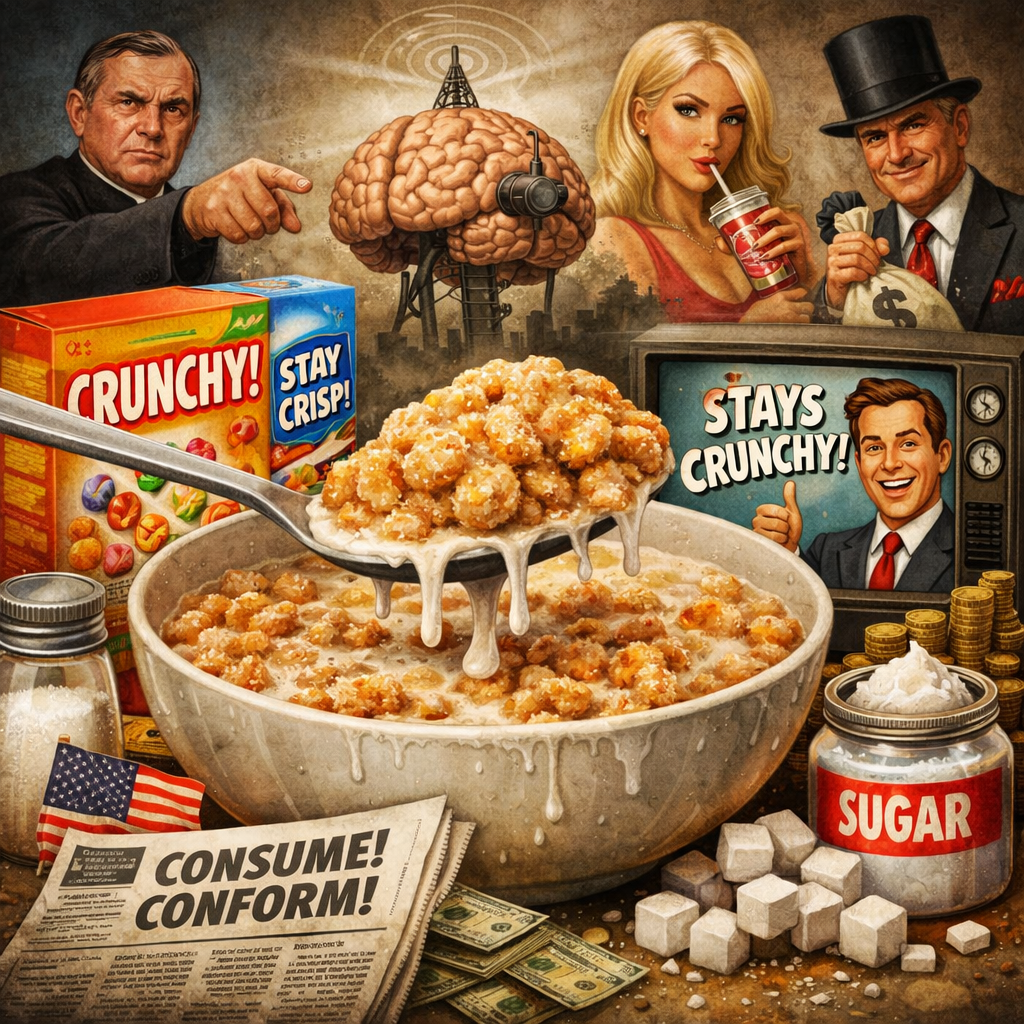
Confession time: I like my breakfast cereal soggy. There, I’ve said it. Yep, I like it to soak up the milk like the most absorbent of sponges, becoming so saturated that you can’t tell where the cereal ends and the milk begins. Apparently eating cereal without sound effects is a sacrilege, because the cereal makers have long been advocates for cereal apartheid, actively striving to develop and market a product that “stays crunchy longer” by adjusting moisture content, adding sugar or glaze coatings (yum), and altering density and shape. So those little neon colored, sugar bombed nuggets are more likely to get lodged between your teeth. Aren’t you thrilled? Do most cereal aficionados really prefer their morning bowl this way? I don’t know. But if they do, I strongly suspect that it’s only because someone on Madison or whatever Avenue decided they should, and began hyping that particular attribute.
Because let’s face it, there’s a long history of the public being told what its preferences are. There’s a nearly universal assumption that people prefer their drinking water iced or chilled, no matter the outside temperature. And while it’s certainly true that a frosty liquid is most welcome on a stiflingly hot day, the practice of chilling water carries over even into the middle of winter. Go into a restaurant in Alaska in January, and the server is likely to fill your glass with ice cubes automatically unless you request otherwise.
And if you’re ever on a long drive and decide you’d like a snack, so you pull over at a quick shop, good luck finding nuts that are not salted. In fact, good luck finding anything that isn’t salted and/ or sugared to oblivion. You’re just supposed to like it that way, dang it. To go along with your ice water. It has become common knowledge that Americans just love salt and sugar, and can’t taste their food unless one or more of those sacred substances is present. (To be clear, though, sugar is often added to foods simply because it’s a cheap way to increase weight, and thereby profit. But in order to make it profitable, manufacturers had to convince consumers they were fond of the sticky sweetness.) Even in peanut butter. The thing is, if you really like salt and sugar in your peanut butter, it would be very easy to add them yourself — those two ingredients are cheap, and found in almost any kitchen. Instead, the manufacturers have made the pure product the odd rarity that is sold at a premium price.
As a tea connoisseur, I’m rather fond of a variety called white tea. And at one time you could buy it in several major supermarkets. Well, you still can — except that someone decided tea drinkers actually wanted their white tea fruit-flavored. So the last time I checked, it was practically impossible to find just plain old white tea anymore.
Perhaps the widespread presumption that someone else should be dictating our preferences got started with religion. In the Long Ago, the common folk were admonished by the clergy not to dress too gaudily or indulge in too much idle recreation and revelry, lest the Lord be mightily displeased. After years and generations of living under these proscriptions, the good folk started believing that this was actually how they themselves wanted to live. External imposition was transformed into internal virtue.
Whatever its origins, the dictated preference has become so pervasive that it has been quite easy for commercial interests to exploit it for profit. Coloring is added to everything from breakfast cereal to hot dogs to toilet paper. Flavoring is added to everything from toothpaste to all processed foods to vitamins — apparently we’re really supposed to love gummies now. Fragrances are added to everything from detergent to shampoo to toilet paper to human beings.
Nowhere is this more evident than in feminine fashion and grooming. Women have become convinced that they are more more appealing if they paint their faces like clowns (indeed, that they are drab if they don’t), and wear spikes on their heels that wrench their spines into harmful postures. Even the “wasp waist” look that nowadays is considered the Hollywood/ Barbie ideal figure for women is a relatively modern invention. During most periods of history, women with more robust physiques were considered healthier looking and more attractive. But in the past century or so, the public has been repeatedly and consistently told that it prefers the hourglass frame, to the point that some females are willing to indulge in anorexic behavior to achieve and maintain it.
Nor are the hombres immune to this kind of taste manipulation. Far back in antiquity, someone decided that men liked having their beards removed, and since then most men have played along at most times — although there have also been periods when men were told that beards were more masculine, cooler, groovier.
There was a time when American men thought they considered a hat a vital component of their formal attire. And then Americans elected as president an individualist named John F. Kennedy, who detested hats and refused to don one, even for a photo op. (If you had hair as pretty as his, you might feel the same.) And since Americans believe they like whatever celebrities do and don’t, hats quickly fell into disfavor. These days, most men believe they don’t prefer to include a hat (they’d even be considered oddballs if they wore them) in their business ensembles — which almost always includes a tie, because hey that’s just the way it is.
Alas, it isn’t just what we eat and drink and how we dress or groom that is dictated by irrational social pressures. It’s also the choices we make that are far more momentous.
About a week before the 2024 election, the Gallup organization polled voters on their preferences on various issues between the two major candidates — without telling them whose position was whose. By an overwhelming margin, respondents selected the platform of Kamala Harris as their favorite. Even most Republicans — yes, the party utterly consumed by MAGA hysteria — generally approved of her stances. Yet she lost the election by a somewhat decisive margin. Why? Because voters had been convinced that they didn’t like her, when they actually did. Quite an achievement.
But then the manipulators had an enormous labor force and limitless resources to make it happen: Fox “News” and all its clones, and various Internet rumor mills and Youtube videos, fueled by an endless stream of dollars. Every day, around the clock, they tell you what you think and how you feel and what you like and don’t like, so you don’t have to give it any thought.
They tell you that you have a mortal fear of “illegal” immigrants and want them all shipped far away.
You don’t. These immigrants do your landscaping and harvest your crops and cook your meals and gut your chickens. And you’re surrounded by them, and they never harm you.
They tell you that you’re worried about transgenders taking over women’s sports.
You’re not. Only a scant handful of transgenders have ever competed in women’s sports, and they haven’t performed that well.
They tell you that you consider gays to be “sinful”.
You don’t. You are on good terms with quite a few of them, whether you realize it or not. If you’re a church person, they sit in the same pew you do, probably at least one on either side, and worship the same god and read the same scriptures you do.
A modest proposal: the next time you have an impulse to drink ice water, or put silos on your feet, or reach for rainbow-colored cereal that can be molded into a life raft, or vote for a malignant infantile delusional megalomaniac over a black woman, maybe you should pause a moment to ask yourself why. If you really and truly prefer those options, well and good. If you’re merely going along with the herd notions of what you should like, you might want to take stock of the extent to which your choices actually might be hand-me-down tastes.


[…] The Propaganda Professor has come up with another winner, beginning with a food rebellion against the preferences dictated by popular media: […]
Smith Tea in Portland, OR has white tea – can also be purchase from them online, from Republic of Tea, from (shudder) amazon,and sometimes in supermarkets. It’s more expensive than supermarket generic teas, but worth it.
Thanks for the tip.