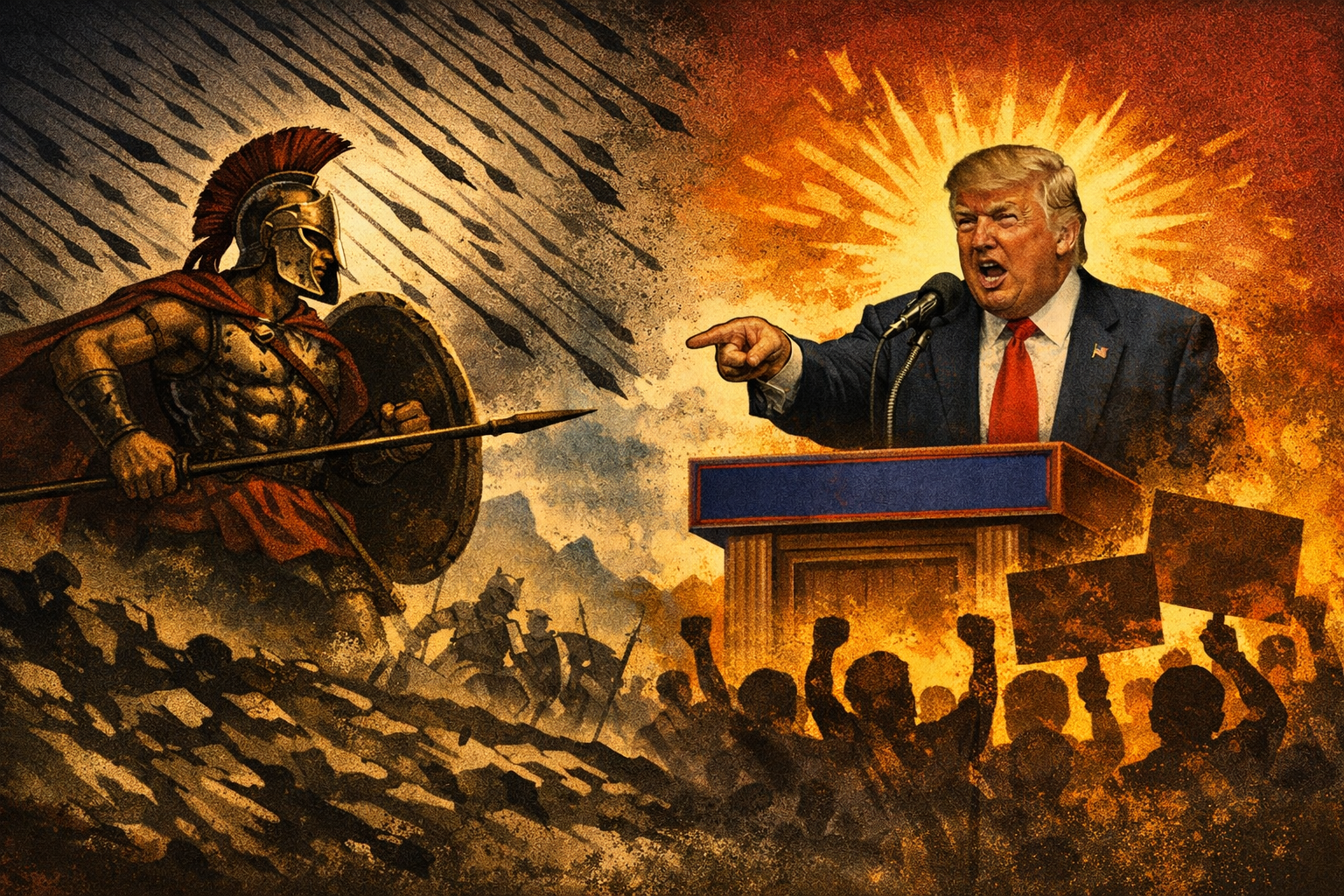
Legend has it that a Spartan soldier at the Battle Of Thermopylae responded to a warning from the enemy that their arrows would blot out the sun by saying he welcomed this news, for then they could fight in the shade. The Spartans may have lost the battle on the field, but they won the battle of rhetoric with exaggeration, otherwise known as hyperbole (four syllables with the accent on the second, kiddies). We all use hyperbole without even giving it a thought: “I’m starving”; “She was over the moon”; “He’s faster than lightning”. It’s a useful and legitimate tool for emphasis. But it can be used deliberately for disingenuous effect — not only to emphasis a premise (often a false one) but to mislead people into thinking that the exaggeration is literal fact. And political and media figures frequently do both.
In fact, at this writing we’re living in a Golden Age of hyperbole. Because the guy in the White House tells us we’re living in a Golden Age for America. Indeed, just about every time he opens his mouth a hyperbole pops out and explodes. He’s the greatest president ever. The election he lost had the most cheating ever. America is enjoying its strongest economy ever. He’s the most persecuted and unfairly treated person in history. His hyperboles are so frequent, so overblown, so embarrassingly transparent, that you’d think they’d never fool anyone with half a brain. But you must be mistaken, because the MAGA Cult laps them up. And repeats them. Not only do they believe the underlying concept (which is usually quite wrong), but they gobble up the exaggerated version in its literal sense.
Meanwhile, it’s virtually impossible to use negative hyperbole about the man himself, because just about anything you said would pretty much be on the money. He’s a walking textbook in many ways, including frequent display of every single variety of propaganda, and every single variety of hyperbole. Here are the main types. (There will be some overlap at times.)
1. Exaggeration Of Number or Degree
“Millions of people are voting illegally”. “Violence is spiraling out of control.” “The protesters were a lawless mob.” “College students are pro-Palestine/ antisemitic”. “Vaccines kill people”. “Guns prevent crime”. “Illegal border crossings have been reduced to zero.” “Transgenders are taking over women’s sports.”
2. Mischaracterization
“Immigrants are invading the country”. “Liberals support killing babies”. “I ended eight wars.” “Lawfare”. “Communism.” “Biden targeted parents.” “Renee Good was a terrorist.”
Terrorist / terrorism is one of the most frequent mischaracterizations these days. The Felon even used the power of his office to officially label the (nonexistent) group Antifa as terrorists. (Did somebody say “lawfare”?) And in Obama’s day, Republicans played up his association with a former member of The Weathermen, to suggest that he was “palling around with terrorists”.
But The Weathermen were never terrorists, or at least they never committed terrorist activity. They were saboteurs. Like terrorists, saboteurs make use of explosives and other destructive devices, but that’s about as far as the similarity goes. Saboteurs attack property; terrorists attack and kill people. The only fatalities as a result of Weathermen activity were three of their own band, in an accidental explosion. (One former member, however, reported that they had been planning to bomb an event at which people were present.) When terrorists kill people, it’s rarely an accident.
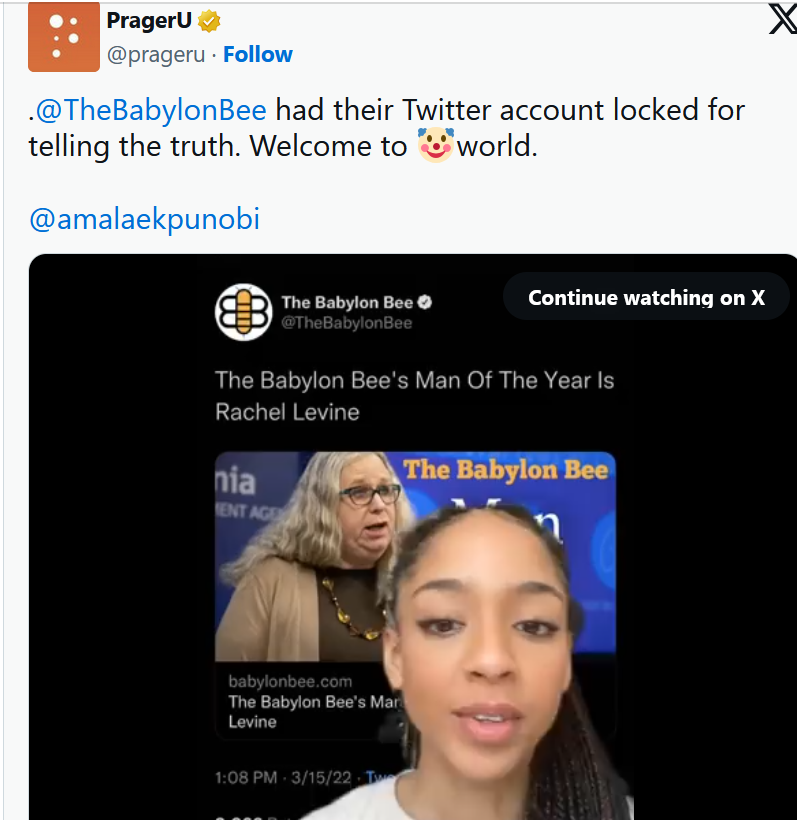
And speaking of mischaracterization, our dear old friends at PragerU are quite accomplished in the art. Here they give you two mischaracterizations for the price of one:
3. Glorification
“Make America great again.” “America first.” “Everything is going beautifully.” “We’re number one.”
4. Fearmongering
“If you vote for my opponent, we will have World War III.” “Democrats are trying to destroy Christianity”.
Dire warnings about an imaginary threat constitute a propaganda technique in their own right, which we’ll be examining more closely in the future.
5. Comparison
For better or for worse, propagandists often liken people or things to someone or something else that is either sublime or quintessentially loathsome. The MAGA Cult is fond of characterizing its favorite felon as a Moses, a Messiah, a superhero — even though he bears absolutely no resemblance to any of the above.
On the negative side, the ultimate analogue — and perhaps the most common one — is Hitler/ Nazis. This extreme among extremes is sometimes invoked for things so minor as trying to keep The Ten Commandments out of a courthouse. It would be much closer to accurate if invoked in relation to trying to put The Ten Commandments in the courthouse. But even then that would be a huge stretch.
To be clear, not all Hitlerisms are entirely inappropriate. Increasingly these days, you see government actions that are very much akin to what happened in the Third Reich — usually not in degree, but still in kind (e.g., shooting demonstrators in the street and locking up immigrants). Others are apt comparisons in both degree and kind — e.g., browbeating the media and interfering in elections.
6. Understatement
Technically, understatement is the antithesis of hyperbole. But the two are so inextricably linked that they can be lumped together. After all, understatement can be thought of as overstating innocuousness or normalcy. The January 6 Capitol Riot, for instance, frequently has been called a “peaceful protest” or even just “a group of tourists”. And speaking of The White House Felon, as we regrettably must, the media bear a large part of the burden of culpability for inflicting him upon the world by severely downplaying his insanity and ineptitude. Every time he comes up with some batshit statement or action, you can count on a large portion of the media coverage to sanewash him by framing his words or deeds as merely “unconventional” or “unique” or somedamnsuch.
With all these types of exaggeration and misrepresentation bombarding us constantly like a hurricane, hyperbole has become so commonplace that it’s barely heeded anymore. If you do not exaggerate, people tend to think you must be wrong, or lacking in the depth of your convictions. Hyperbole has become the new lingua franca.
And it’s not much of an exaggeration to say that’s no exaggeration.

