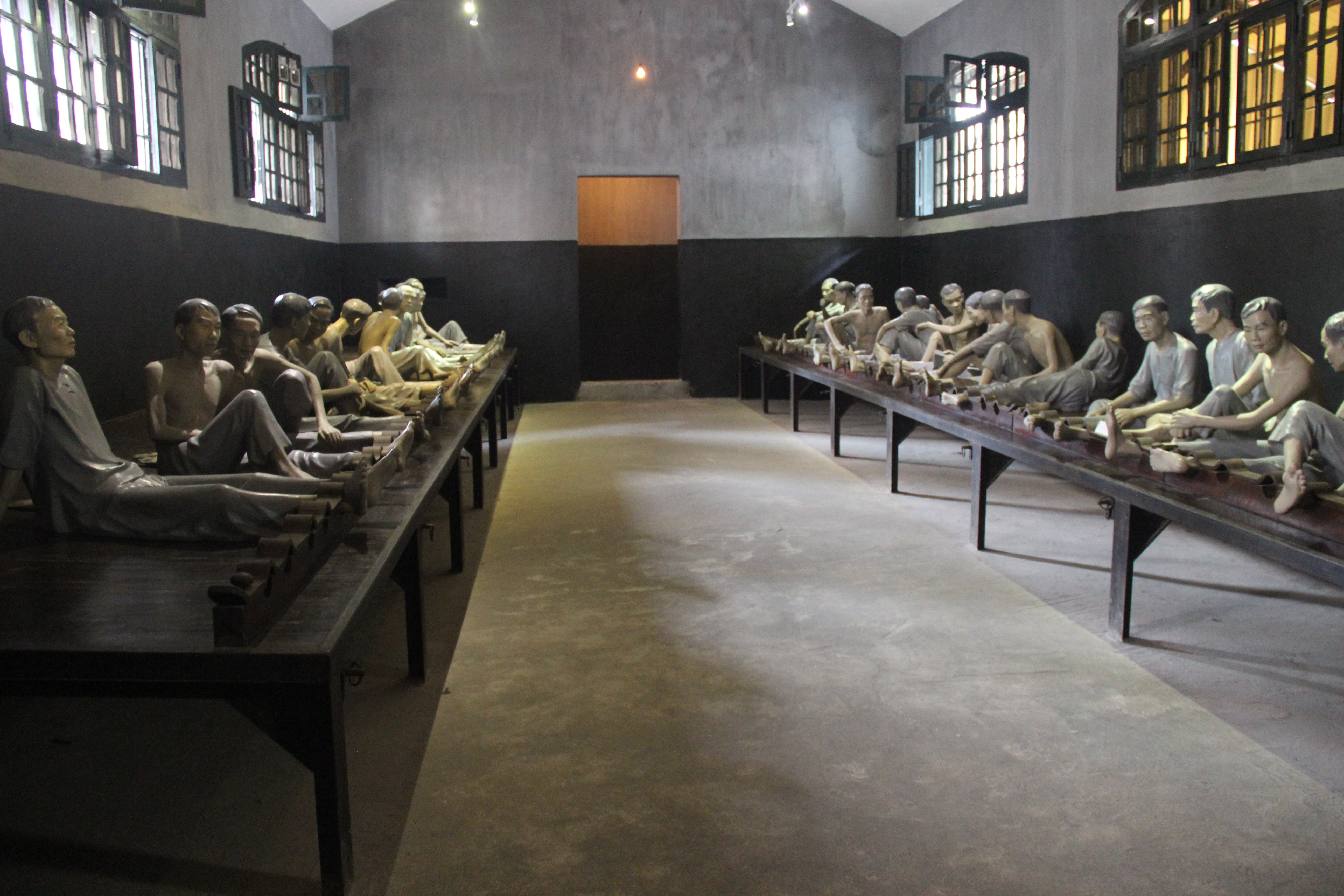
Not long ago while visiting Vietnam I was able to take a tour of the museum at the former site of the notorious Hoa Lo Prison, better known to Americans as the “Hanoi Hilton” — a sarcastic sobriquet conferred on the place by American POW’s because of the brutal treatment they received there during the Vietnam War. Not surprisingly, the Vietnamese government denies that these prisoners were tortured; the signage at the prison insists that they were well treated, and there are even exhibits of photos and a film clip that tend to substantiate that claim. Which caused me to pause for a moment and ponder the allegation sometimes made that the Vietnamese version was actually correct. Was it possible that the Americans’ reports of atrocities during captivity were either (a) a well-coordinated fabrication, or (b) a collective false memory?
These scenarios, far-fetched as they sound, were prompted in part because I’d already been thinking about the narrative of the spat-upon veteran. Surely you’ve heard such anecdotes, particularly if you have RRR’s (rabidly right-wing relatives) who excoriate anti-war protesters, and believe U.S. military personnel can do no wrong.
According to the widespread accounts, protesters of the Vietnam imbroglio frequently spat on soldiers returning from Vietnam. Some veterans (or avowed veterans) have claimed to have been among the recipients of the hostile saliva. Occasionally, there even has been an individual who claimed to have been among the spit donors. According to one popular anecdote, protesters lined up at the San Francisco airport to welcome the returning soldiers in this manner.
But there are numerous problems with this folk narrative. For one thing, there is zero unambiguous evidence to corroborate it. No photos, no videos, no news accounts, nothing. Furthermore, these stories didn’t start surfacing until at least 15 years or so after the fact. Nobody in real time was making these claims. Additionally, many of the specific incidents are highly implausible at best.
The San Francisco incident is an excellent case in point. A plane load of returning troops would not have landed at a public airport, but at a military base. And how would anyone know, just by seeing someone in uniform, whether they’d been to Southeast Asia? And even if they did, they were far more likely to be sympathetic than hostile. (Remember, the draft was in effect at this time, so everyone knew that many young men went to war against their will.) According to one survey, only three percent of military personnel at the time reported encountering any hostility at all.
The protesters against the Vietnam involvement, in fact, often included veterans who had been there — quite frequently, they were among the organizers of such protests. In short, if it really did transpire that someone spat upon a soldier, it was probably a rare occurrence rather than a trend. So what about all the people who insist that they witnessed, or were a part of, such episodes? Are they either lying or remembering something that didn’t really happen? Stranger things have happened. And there are not infrequently cases of false memory on a mass scale.
There’s even a scientific name for it: the Mandela Effect, a designation assigned because a large number of people believed that Nelson Mandela had died in prison during the 1980s. In fact, he was released in 1990 and didn’t die until 2013. And many people swore that comedian Sinbad had starred as a genie in a movie called Shazaam. In fact, Sinbad has not portrayed a genie to date, and no film with that title has ever been made. Hundreds, thousands, maybe even millions of folks have insisted they were watching The Tonight Show when Johnny Carson delivered a certain risque punchline to Zsa Zsa Gabor about her cat. But it never happened. Oh yes, and Darth Vader never said, “Luke, I am your father.” (He said, “No, I am your father.”)
Even at its best, personal memory is not a recording device but an interpretive device. Studies conducted after the explosion of the space shuttle Challenger revealed that almost all the participants had memories of the disaster that changed dramatically in a matter of months. Even when the respondents initially reported recollections around the event that were vivid and emotional, the details described diverged significantly and sometimes drastically over time. And their degree of clarity and confidence about their recollections did not correlate with accuracy of recall.
Which brings us back to the former residents of the Hanoi Hilton. They were not recalling a single traumatic occurrence (often termed a flashbulb memory) but a prolonged series of experiences and conditions. All taking place in a confined and sensory deprived setting which could have eliminated much of the distortion that results from normal daily activities.
Still, what are the chances that the POW’s simply lied about their experiences? Well, slim to none. At least 65 American POW’s died in captivity, which would really be going to extremes if you’re just faking it. At the very least, it shows gross neglect on the part of the captors. And those who returned home brought bodily evidence of their ordeals, including scars, broken bones and dislocated joints. It’s possible to sustain such injuries in other ways, but the fact that virtually all the internees at this camp had such corporeal souvenirs might be considered just a bit suspicious. Moreover, the accounts that the former prisoners gave of their ordeals are highly detailed and strikingly consistent in their detail — something hard to pull off if you’re fabricating a group yarn. In other words, this is definitely not a manifestation of The Challenger Effect, which involves variations in the memories of one individual’s experiences.
But is it possible that they exhibited the Mandela Effect? That’s also quite improbable, for the same reasons stated above. It’s true that they showed confusion and uncertainty about certain things; that happens with victims of abuse and severe trauma. So it’s possible that some of their stories might be a bit distorted. But probably not in any major way.
One other thing worth pointing out is that the American section is only a part of the exhibits at Hoa Lo, and a minority part at that. Most of the space is devoted to the abuse that the Vietnamese themselves were subjected to by their French oppressors before Vietnam attained its independence. The exhibits paint a savage and sometimes graphic picture of systematic and regular torture. Which is to say that the Vietnamese inherited a facility for detainment already well stocked with implements of torture, and they had first-hand exposure to the techniques for putting them to use. What are the odds that they didn’t turn around and put them to use themselves? Especially since it’s a sad fact of life that virtually every nation tortures military and political prisoners to some degree or other.
Yet the Vietnamese government denies it all. So the question is, do governments ever lie to us?


Governments have lied to their people at least since the Battle of Kadesh, 13th century BC where both sides, Egyptians and Hittites, claimed victory.
However, I would guess that as long as the populace has enough to eat the governments that lie to them are probably safe.
I’d bet that governments have been lying ever since the first tribal council assembled in the cave community.